Upper Mustang: Trek Blends Culture and Desert Mystique

Discover the Upper Mustang Trek, a journey into Nepal’s “Last Forbidden Kingdom,” nestled beyond the towering Annapurna and Dhaulagiri peaks. For centuries, this remote land remained sealed, preserving a vibrant time capsule of ancient Tibetan traditions. Since opening to trekkers in 1992, Upper Mustang invites adventurers and cultural explorers to uncover its surreal deserts, sacred monasteries, and timeless heritage.

A Realm Frozen in Time
Once a thriving trade hub between Nepal and Tibet, Upper Mustang was the heart of the Kingdom of Lo. For example, its medieval capital, Lo Manthang, founded in 1380 by Ame Pal, still stands as a fortress of culture, encircled by a 6-meter-high wall. Even after the last king, Jigme Dorje Palbar Bista, passed in 2016, the region’s Tibetan heritage thrives—untouched by time.

Furthermore, Nepal shielded Upper Mustang from outsiders for decades to preserve its sanctity and proximity to Tibet. Consequently, it earned the title “Forbidden Kingdom,” safeguarding one of the world’s purest Tibetan Buddhist cultures. When the gates opened in 1992, a rare window into this sacred world was revealed.

The Trek of a Lifetime: Why Upper Mustang Captivates
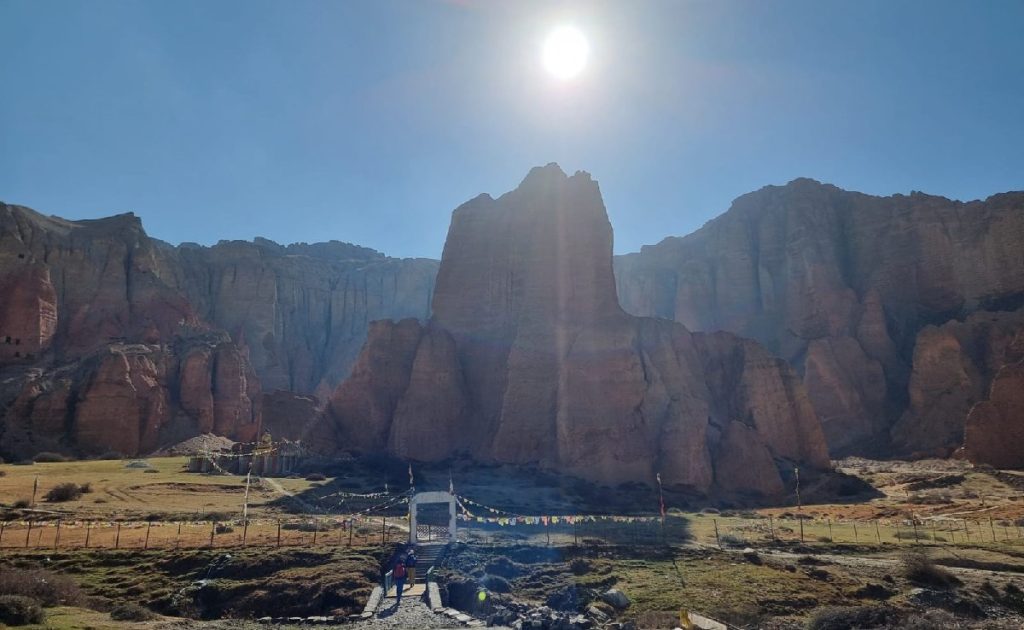
Upper Mustang

Unlike Nepal’s lush, alpine trails, Upper Mustang offers a surreal journey through a high-desert wonderland. Here’s why it’s unforgettable:

  • Otherworldly Landscapes: Picture wind-carved cliffs and golden rock formations glowing under a vast sky. For instance, in the rain shadow of Annapurna and Dhaulagiri, Mustang’s arid terrain feels like a Martian plateau. Meanwhile, dazzling views of Nilgiri and Dhaulagiri peaks add breathtaking contrast.

  • Living Tibetan Heritage: Immerse yourself in a culture unchanged for centuries. Specifically, you can visit 500-year-old monasteries adorned with vibrant murals or explore mysterious sky caves holding ancient relics. Additionally, the Tiji Festival in Lo Manthang—a three-day spectacle of masked dances—banishes evil spirits in vibrant style.

  • Exclusive Adventure: Strict permits limit visitors, ensuring an intimate trek. Therefore, this isn’t Everest’s hustle—it’s a pilgrimage through a sacred, silent land.

  • Cultural Connection: For example, chatting with monks or sipping butter tea in village teahouses lets you feel the pulse of a living Buddhist tradition.

Journey Through the Forbidden: Trek Highlights

A 12- to 16-day trek begins with a scenic flight from Pokhara to Jomsom, launching you into Upper Mustang’s magic. Key stops include:

  • Kagbeni: The gateway village, where prayer flags dance and the Kali Gandaki River roars.
  • Chele & Syangboche: Meanwhile, these cliffside hamlets feature ancient cave dwellings carved into rock faces.
  • Geling & Ghami: Wander past endless mani walls and golden barley fields swaying in the wind.
  • Charang: For instance, marvel at a red-walled monastery and a crumbling palace steeped in history.
  • Lo Manthang: The heart of Mustang, a walled city of royal palaces and gompas humming with chants.
  • Chhoser Caves: Additionally, optional detours lead to eerie, ancient caves hiding archaeological treasures.

At a moderate 3,800m max altitude, this trek focuses less on grueling climbs and more on history and culture. Typically, expect 5-6 hours of daily trekking, ideal for fit adventurers with a thirst for discovery.

Planning Your Trek: Permits & Logistics

To protect its fragile heritage, Upper Mustang’s exclusivity comes with specific rules:

  • Permit: A Restricted Area Permit (RAP) costs USD 500 per person for 10 days, plus USD 50/day thereafter.
  • Group Size: For example, a minimum of 2 trekkers, accompanied by a licensed Nepali guide, is required.
  • Access: Fly or drive to Jomsom, then trek from Kagbeni, the official entry point.

As a result, these measures keep Mustang pristine, ensuring your journey supports local communities and conservation.

Who Should Trek Upper Mustang?
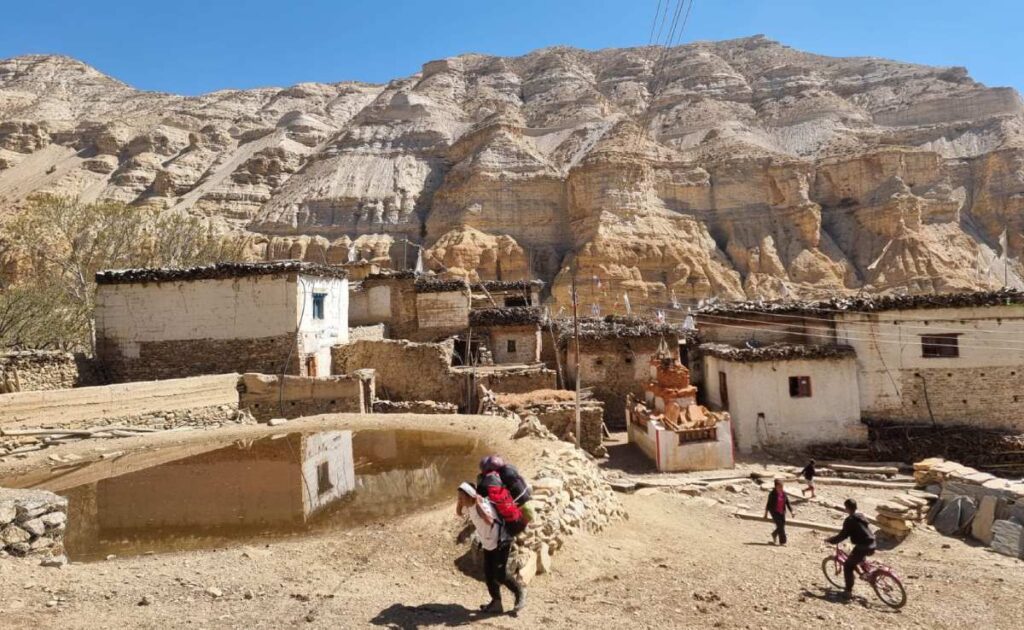
This trek is perfect for:

  • Cultural Explorers: Dive into Tibetan Buddhist traditions and ancient history.
  • Adventure Seekers: For instance, those craving a trail far from tourist crowds will love it.
  • Seasoned Nepal Travelers: Ready to venture beyond Annapurna or Everest? This is your trek.
  • Spiritual Wanderers: Additionally, it’s ideal for those seeking meditation in sacred spaces.

While moderate fitness is needed, the real requirement is a heart open to wonder and respect for Mustang’s sanctity.

Treading Lightly: Responsible Tourism

Thanks to careful stewardship, Upper Mustang’s magic endures. Specifically:

  • Community Lodges: Stay in local teahouses, directly supporting families.
  • Conservation: For example, the Annapurna Conservation Area Project (ACAP) protects the region’s ecology and culture.
  • Eco-Ethics: Moreover, strict waste rules preserve the pristine landscape.

Thus, your trek becomes a commitment to safeguarding a sacred legacy.

Step Into the Forbidden Kingdom

Upper Mustang isn’t just a trek; it’s a portal to a forgotten world. Prayer flags ripple in the desert breeze, monks chant in candlelit gompas, and ancient caves guard stories of lost eras. In other words, this is where the Himalayas meet the surreal, where every step feels like a pilgrimage.

Ready to explore? Let Himalayan Circuit , experts in Nepal’s hidden gems, craft your fully guided Upper Mustang adventure—permits, guides, and cultural insights included.

Travel Diaries: How Travel Magazines of Nepal Inspire Journeys

travel magazines of Nepal

Travel media continues to shape how visitors experience Nepal. Beyond blogs and social media, travel magazines of Nepal offer clear stories, reliable information, and stunning visuals. These publications keep Nepal on the radar of global travelers while providing practical tips for trip planning.

For travelers, these magazines act as trusted Nepal travel guides, offering culturally rich alternatives beyond Everest and Pokhara. For advertisers, they provide platforms for visibility. In addition, they promote tourism by showcasing Nepal’s diversity.

Why Travel Magazines Matter in Nepal

Tourism in Nepal is seasonal and experience-based, so visibility is crucial. Therefore, travel magazines play a key role in storytelling. They connect urban readers, diaspora communities, airlines, and potential visitors.

For example, these magazines highlight:

  • New trekking trails
  • Boutique hotels
  • Heritage restorations
  • Festivals and conservation efforts
  • Adventure products

Because their content is locally sourced and edited, it is more relevant than generic international coverage. As a result, they give tourism entrepreneurs—guides, resort owners, airlines, a voice to share authentic stories. This helps position Nepal as more than “just mountains.”

Popular Travel Magazines in Nepal

1. Yatra Travel Magazine (Buddha Air)

Yatra reaches in-flight audiences across Nepal, including business travelers, diplomats, and domestic tourists. Each edition blends destination highlights like Mustang, Ilam, and Lumbini with lifestyle content on food, hotels, and travel personalities.

Moreover, for advertisers, Yatra offers direct access to active travelers. For readers, it serves as a practical guide to domestic travel.

2. Parikrama Magazine (Nepal Traveller)

Parikrama focuses on premium tourism and hospitality. Its polished tone appeals to hotels, tour operators, and DMCs. Articles cover heritage towns, boutique experiences, and new openings. Written in English, it targets overseas audiences and returnee Nepalis. Consequently, it is ideal for understanding Nepal’s tourism industry.

3. Wanderlust Travel Magazine

Wanderlust emphasizes photography and inspirational travel. It showcases trekking, mountain flights, rafting weekends, and community homestays. For instance, short getaway ideas like Nagarkot, Dhulikhel, Bandipur, and Bardia encourage balanced tourist movement and support local economies. Therefore, it works well for younger or first-time travelers.

4. ECS Nepal

ECS stands out for cultural depth. It covers heritage sites, artisans, Newar towns, food culture, monastery life, and festivals. ECS appeals to visitors and residents who want to explore Nepal beyond itineraries. In addition, its long-form, researched content encourages travelers to stay longer and spend more.

5. Outlook Travel Magazine

Outlook places Nepal in a broader South Asian context. It highlights trekking, wildlife, heritage, national parks, wellness retreats, and aviation developments. As a result, it builds credibility with international audiences. For travelers, it serves as an early-stage planning guide, showing Nepal as an enticing destination.

Final Thoughts

Nepal’s tourism strategy embraces travel magazines because “the more, the merrier” applies to tourism promotion. These magazines capture new destinations, document local entrepreneurs, and preserve culture. Ultimately, for travel operators, advertising in these magazines is a smart way to reach audiences. For readers, they offer inspiration and practical guidance, magazines you can hold, bookmark, and travel with.

Kathmandu Diaries: Exploring the Sacred Monasteries of the Valley

Monasteries in Kathmandu

Nepal is a sacred land with deep spiritual roots and ancient traditions. The Kathmandu Valley monasteries are central to this heritage, reflecting centuries of Buddhist teachings. Today, these monasteries continue to welcome travelers from around the world, offering meditation, learning, and spiritual experiences. Moreover, they provide a peaceful retreat amid the vibrant culture of Kathmandu.

This guide highlights the most remarkable monasteries in the Kathmandu Valley, focusing on their cultural, architectural, and spiritual significance.

Why Visit Kathmandu Valley Monasteries?

Monasteries in Kathmandu

The monasteries in Kathmandu are more than historical sites. In addition, they are active centers of learning, meditation, and spiritual practice. Visitors can witness early morning chants, spin prayer wheels, or light butter lamps, creating a personal and reflective experience.

Furthermore, many monasteries are set in serene locations with beautiful gardens, panoramic views, and peaceful courtyards. These spaces not only allow spiritual growth but also offer a chance to connect with Nepal’s rich Buddhist heritage.

Top Local Monasteries to Explore

Kopan Monastery

Founded in the 1970s by Lama Yeshe and Lama Zopa Rinpoche, Kopan Monastery is a hub for meditation and Buddhist studies. Located on a quiet hill north of Boudhanath, it offers panoramic views of the Kathmandu Valley and beautiful gardens.

Visitors can join meditation retreats, learn Buddhist philosophy, and experience monastic life in a calm, contemplative setting. As a result, Kopan attracts students and travelers from around the world seeking mindfulness and inner peace.

Shechen Monastery

Shechen Monastery, near Boudhanath Stupa, is a vibrant center of Tibetan Buddhist culture. Established by the revered Dilgo Khyentse Rinpoche, it promotes spiritual and cultural teachings of the Nyingma tradition.

The monastery hosts hundreds of monks and offers teachings, rituals, and monastic education. Moreover, its traditional architecture harmonizes with the peaceful surroundings, making it perfect for meditation and reflection.

Thrangu Tashi Yangtse Monastery

Located in Namo Buddha, this monastery was founded in 1979 by Khyabje Thrangu Rinpoche. Following the Kagyu tradition, it serves as a training center for over 250 monks.

The complex features golden arched roofs, multiple buildings, and ceremonial spaces. Visitors can observe ritual practices, study Dharma, or simply enjoy the serene environment of this sacred site.

Druk Amitabh Mountain Monastery

Situated on a hill in Nagarjun Municipality, Druk Amitabh Monastery serves as a center for spiritual practice and humanitarian activities. It includes a multi-purpose assembly hall, a library, a medical clinic, and quarters for nuns.

In addition, the monastery supports the Kung Fu Nuns community, adding a unique dimension to its spiritual environment. Its serene location near Swayambhu makes it ideal for meditation and reflection.

 Dhagpo Sheydrub Ling Monastery

This Kagyu tradition monastery, located in Nala near Bhaktapur, blends Newar craftsmanship with Tibetan aesthetics. It features vibrant murals, fluttering prayer flags, and traditional architecture.

Visitors can participate in meditation retreats, cultural programs, and educational courses, gaining insight into Nepal’s Buddhist heritage.

White Gumba

White Gumba reflects purity, simplicity, and nature-inspired wisdom. Established by visionary Buddhist scholars, it preserves Tibetan Buddhist traditions while integrating local Nepali architectural influences.

As a result, the monastery draws both local devotees and international travelers seeking spiritual learning and a peaceful environment.

Final Thoughts

The Kathmandu Valley monasteries are gateways to inner peace and spiritual growth. In addition, they offer a rare stillness amid the lively city, making every visit meaningful.

By exploring these sacred spaces, travelers can reconnect with themselves and experience the heart of Nepalese Buddhist culture. Therefore, plan your trip with the Himalayan Circuit to explore, reflect, and immerse in Kathmandu’s spiritual treasures.

Nepal Travel News 2025: Recovery, Trends & Tourism Insights

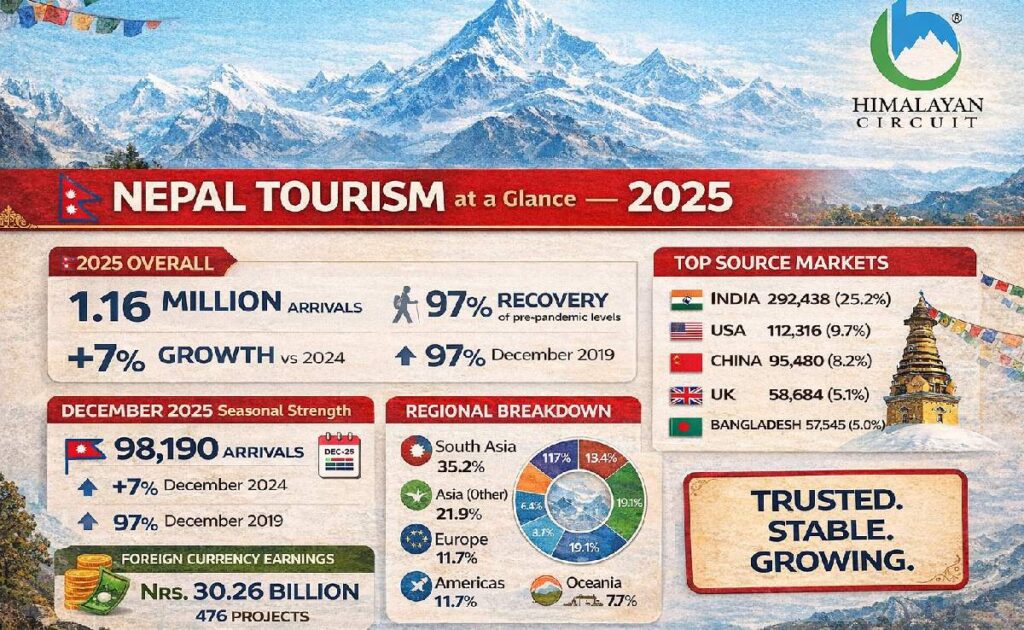
Tourism in Nepal demonstrated strong resilience and maturity in 2025, successfully reaching near pre-pandemic performance levels while avoiding the pitfalls of mass tourism. According to data and industry insights aligned with the Nepal Tourism Board, Nepal welcomed 1,158,459 international visitors, achieving a 97% recovery compared to 2019.

Rather than being a short-term rebound, 2025 represents a transition year, marking Nepal’s shift from post-pandemic recovery to stable, sustainable, and value-driven growth. Consequently, this evolution creates new opportunities for premium experiences, diversified markets, and higher economic yield per visitor.

Overall Performance Snapshot

  • Total International Visitor Arrivals (IVAs): 1,158,459
  • Recovery Level: 97% of pre-pandemic (2019) arrivals
  • Trend vs 2024: Moderate growth, signaling stabilization

Key Insight:
Nepal’s tourism recovery has been measured and balanced, avoiding overtourism and excessive discounting. As a result, the destination is well-positioned for long-term competitiveness, rather than short-lived volume spikes.

Seasonal Performance: Why December 2025 Matters

December 2025 recorded 98,190 international arrivals, reflecting:

  • +7% year-on-year growth compared to December 2024

  • 97% recovery compared to December 2019

What This Indicates:
Winter tourism in Nepal is no longer a secondary season. Instead, demand for winter trekking, cultural tours, wellness travel, and soft adventure remains consistent and dependable.

Strategic Opportunity:
Therefore, the winter season provides an ideal platform to promote luxury trekking, boutique lodges, slow travel, wellness retreats, photography tours, and curated cultural journeys, particularly for long-haul markets.

Top Source Markets

Market Share Strategic Interpretation
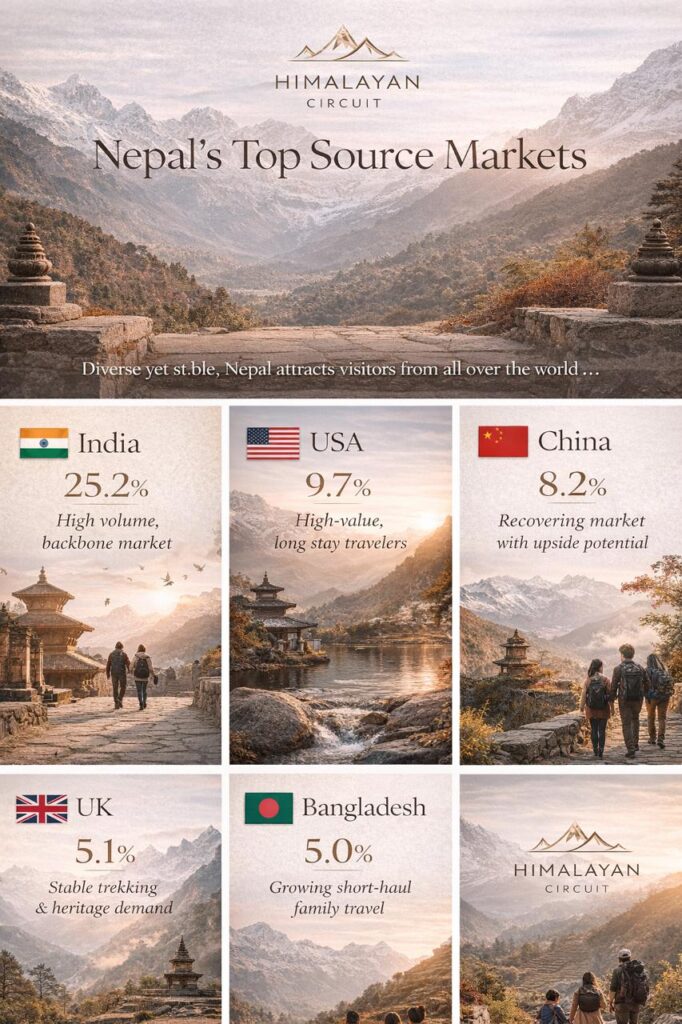
India 25.2% High volume, low yield; backbone market
USA 9.7% High-value, long-stay travelers
China 8.2% Recovering market with strong upside
UK 5.1% Stable trekking and heritage demand
Bangladesh 5.0% Growing short-haul family travel

Market Insight:
Nepal benefits from a diversified source market mix, which reduces dependency risk. However, while India dominates in volume, long-haul travelers from the USA and Europe contribute disproportionately to tourism income.

Region-Wise Distribution: Volume vs Value

  • South Asia (35.2%) – High volume, price-sensitive
  • Asia (Other) (21.9%) – Growth engine (China, Southeast Asia, Korea, Japan)
  • Europe (19.1%) – Core trekking and cultural market
  • Americas (11.7%) – Highest spending per visitor
  • Oceania (4.6%) – Loyal adventure niche
  • Middle East, Africa & Others (7.7%) – Emerging and under-tapped

Opportunity for Tourism in Nepal:
Thus, the future growth strategy should shift focus from merely increasing arrival numbers to maximizing revenue per visitor, which will reduce pressure on infrastructure while increasing economic impact.

Economic Impact: Confidence Beyond Arrivals

Foreign Currency Earnings:
In the first four months of FY 82/83 (Shrawan–Kartik), tourism generated NRs. 27,152.55 million in foreign currency.

Interpretation:
This early-year performance indicates healthier pricing, longer stays, and increased service consumption across accommodation, trekking, and experiential tourism.

Tourism Foreign Direct Investment (FDI):

  • NRs. 30,263 million committed
  • 476 tourism-related projects approved

Investor Signal:
These commitments demonstrate that tourism investors are focused on long-term assets such as hotels, eco-resorts, boutique lodges, and trekking infrastructure—signaling confidence in Nepal’s tourism fundamentals.

Key Strengths of Tourism in Nepal

  • Near full recovery without mass tourism pressure
  • Balanced mix of regional and long-haul markets
  • Growing investor confidence and FDI inflow
  • Winter tourism emerging as a core revenue season
  • Strong global reputation in trekking and adventure tourism

Gaps and Risks:

  • Overreliance on low-yield short-haul markets
  • China market recovery still below full potential
  • Infrastructure and service quality gaps for premium positioning
  • Limited global branding beyond trekking

Strategic Recommendations

  1. Move from Volume to Value
    Promote luxury trekking, heli tours, wellness retreats, heritage trails, and slow travel experiences targeting high-spending markets in Europe, the Americas, and Oceania.

  2. Reposition the India Market
    Expand beyond pilgrimage and budget travel to luxury weekend escapes, destination weddings, adventure tourism, and curated experiences.

  3. Accelerate China Market Recovery
    Invest in Mandarin-language content, influencer marketing, improved air connectivity, and digital visibility tailored to Chinese travelers.

  4. Capitalize on FDI Momentum
    Encourage investment in eco-resorts, boutique lodges, community-based tourism, and experiential products that extend length of stay.

  5. Strengthen Winter Branding
    Position Nepal as “More Than Mountains”, highlighting culture, cuisine, festivals, spirituality, wellness, and soft adventure.

Role of Himalayan Circuit

As a Nepal-based tour and trekking specialist, Himalayan Circuit aligns its offerings with Nepal Tourism Board guidelines, focusing on responsible tourism, premium experiences, and authentic journeys. From Himalayan trekking and cultural tours to luxury travel, the company contributes to higher visitor value while preserving destinations and communities.

Conclusion

Tourism in Nepal in 2025 is stable, trusted, and investable, with strong foundations firmly in place. Looking ahead, growth will rely less on increasing arrival numbers and more on enhancing visitor value, upgrading experiences, strengthening destination branding, and targeting the right markets.

Through strategic planning, smart marketing, and close collaboration between the Nepal Tourism Board and responsible private-sector stakeholders such as Himalayan Circuit, Nepal is well-positioned to emerge as a high-value, sustainable, and globally respected destination in the years ahead.